Certainly Obama wasn’t the first illegal president born of a CIA asset in Kenya! However Bush-Bush, Obama and Biden and Harris opened up the floodgates of 30 million illegal immigrants into America with the aid of many illegal immigrants such as Representative Ilhan Omar who believes the only good white man should have chains around him and be enslaved to the New World Order NWO and War Department and Muslim takedown of America ‼️
Certainly Obama wasn’t the first illegal president born of a CIA asset in Kenya! However Bush-Bush, Obama and Biden and Harris opened up the floodgates of 30 million illegal immigrants into America with the aid of many illegal immigrants such as
Representative Ilhan Omar who believes the only good white man should have chains around him and be enslaved to the New World Order NWO, War Department and Muslim takedown of America ‼️
🔴🔴🔴
🆘 America Has Been Usurped By Foreign Natural Allegiances included here as of September 7, 2025‼️
6 Senators
26 House of Representatives
That’s Largely Why They Allowed Over 30 Million Illegal Militant Immigrants To Take Over America Including Social Security, HUD Housing Authorities, Cash Flows‼️
🆘🆘🆘 🆘 America Has Been Usurped By Foreign Natural Allegiances included here as of September 7, 2025‼️
6 Senators
26 House of Representatives
That’s Largely Why They Allowed Over 30 Million Illegal Militant Immigrants To Take Over America Including Social Security, HUD Housing Authorities, Cash Flows‼️


Like AI and everything else in America Time’s cover article of illegal alien terrorist words propaganda fact checked out of existence to hide the fact that The War Department, New World Order NWO, and numerous Presidents since Bush-Bush, Clinton, Obama-Biden, Harris, and many illegal foreign born nationals fill the halls of the Senate and Congress to turn America upside down for the complete takeover of Americans and America‼️
Representative Ilhan Omar Time Magazine 2012 words about white American men, “When white men are in chains then America will be safe!”
Why? Because the three terrorist groups mentioned know white men are somewhat intelligent while many white women are useful in being ignorant and then complicit and complacent with the takeover of the three terrorist entities NWO, foreign nationals in our DC halls of lawmakers, and X-Presidents all in bed together in this great and wonderful takeover in their minds. The white women will gladly partner and incubate countless more foreign born babies that will be bred to be terrorists for the enemy within and outside American borders. Anything to breed white peoples out of existence permanently. All Americans white or other are facing the same propaganda by the three levels of terrorists in America. Thus the 30 million illegal militant immigrants are critical in the coup that originated around WWII when elder President Bush was only a top CIA asset and conglomerate taking America down one day at a time. Both Bush presidents and all the democratic presidents since Clinton and Carter have directed the planned parenthood initiative and helped feed it until over 30 million American babies perished intentionally via abortions.
As noted below in the article from 2012, Ilhan and her family were all complicit and complacent in the Issac War in 2008 time era: Ilhan Omar’s father was trained in America and helped the Commander of troops kill via genocide thousands of people upwards of 5,000 to 10,000, and then ran to American Embassy claiming abuse and suffering under the Somalian genocide— when in fact Ilhan Omar and her family changed their names and hitched free rides to America at American USAID auspices.
The War Department Pentagon knew exactly who Ilhan Omar’s family was and is and what their business in the slaughter of thousands and thousands and thousands and thousands and thousands of people was going on.
Thus Ilhan Omar thrived in America and even married her own illegal militant brother, also implicated in the Somalian genocide in the Isaac War. The Isaac War itself is decades old, and in the area like the rest of Africa, the wars and genocide actually never end. The Muslim Islamic Koran terrorists rule all of Africa and when they are not killing one another as Sunni fight Shiite also known as Shia, all adhere to the terrorist Muslims who incorporate Sharia Law ...Isaac people of Somalia, who are they at a glance? The Isaac People are Muslims never Hebrews or Christians.
Isaaq / Isaq / Ishaak / Isaac
As you will learn the Isaac People of Somalia are derived of Muslims.
Excerpt: According to some genealogical books and Somali tradition, the Isaaq clan was founded in the 13th or 14th century with the arrival of Sheikh Ishaaq Bin Ahmed Bin Mohammed Al Hashimi (Sheikh Ishaaq) from Arabia, a descendant of Ali ibn Abi Talib in Maydh. He settled in the coastal town of Maydh in modern-day northeastern Somaliland, where he married into the local Magaadle clan.

The Isaaq (also Isaq, Ishaak, Isaac) is a Somali clan. It is one of the major Somali clans in the Horn of Africa, with a large and densely populated traditional territory. According to some genealogical books and Somali tradition, the Isaaq clan was founded in the 13th or 14th century with the arrival of Sheikh Ishaaq Bin Ahmed Bin Mohammed Al Hashimi (Sheikh Ishaaq) from Arabia, a descendant of Ali ibn Abi Talib in Maydh. He settled in the coastal town of Maydh in modern-day northeastern Somaliland, where he married into the local Magaadle clan. | 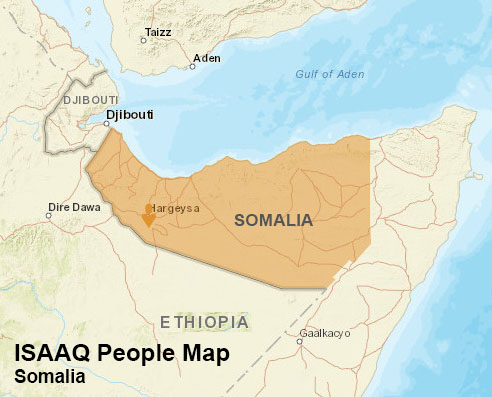 |
There are also numerous existing hagiologies in Arabic which describe Sheikh Ishaaq's travels, works and overall life in modern Somaliland, as well as his movements in Arabia before his arrival. Besides historical sources, one of the more recent printed biographies of Sheikh Ishaaq is the Amjaad of Sheikh Husseen bin Ahmed Darwiish al-Isaaqi as-Soomaali, which was printed in Aden in 1955.
Sheikh Ishaaq's tomb is in Maydh, and is the scene of frequent pilgrimages. Sheikh Ishaaq's mawlid(birthday) is also celebrated every Thursday with a public reading of his manaaqib (a collection of glorious deeds). His Siyaara or pilgrimage is performed annually both within Somaliland and in the diaspora particularly in the Middle East among Isaaq expatriates.
Distribution
The Isaaq have a very wide and densely populated traditional territory. They live in all 6 regions of Somaliland such as Awdal, Marodi Jeh, Togdheer, Sahil, Sanaag and Sool. They have large settlements in the Somali Region of Ethiopia, mainly on the eastern side of Somali Region also known as the Hawd and formerly Reserve Area which is mainly inhabited by the Isaaq sub-clan members. They also have large settlements in both Kenya and Djibouti, making up a large percentage of the Somali population in these two countries respectively.
The Isaaq clan constitute the largest Somali clan in Somaliland. The populations of five major cities in Somaliland – Hargeisa, Burao, Berbera, Erigavo and Gabiley – are all predominantly Isaaq. They exclusively dominate the Marodi Jeh region, and the Togdheer region, and form a majority of the population inhabiting the western and central areas of Sanaag region, including the regional capital Erigavo. The Isaaq also have a large presence in the western and northern parts of Sool region as well, with Habr Je'lo sub-clan of Isaaq living in the Aynabo district whilst the Habr Yunis subclan of Garhajis lives in the eastern part of Xudun district and the very western part of Las Anod district. They also live in the northeast of the Awdal region, with Saad Muse sub-clan being centered around Lughaya and its environs.
The populations of five major cities in Somaliland – Hargeisa, Burao, Berbera, Erigvo and Gabiley – are predominantly Isaaq.
History
The Isaaq clan played a prominent role in the Ethiopian-Adal War (1529–1543, referred to as the "Conquest of Abyssinia") in the army of Ahmad ibn Ibrahim al-Ghazi, I. M. Lewis noted that only the Habr Magadle division (Ayoub, Garhajis, Habr Awal and Arap) of the Isaaq were mentioned in chronicles of that war written by Shihab Al-Din Ahmad Al-Gizany known as Futuh Al Habash.
The first of the tribes to reach Imam Ahmad ibn Ibrahim al-Ghazi were Habr Magādle of the Isaaq clan with their chieftain Ahmad Gurey Bin Hussain Al-Somali, the Somali commander was noted to be one of Imam Ahmad ibn Ibrahim al-Ghazi's "strongest and most able generals". The Habr Magādle clan were highly appreciated and praised by the leader Ahmad ibn Ibrahim al-Ghazi for their bravery and loyalty.
Long after the collapse of the Adal Sultanate, the Isaaq established successor states, the Isaaq Sultanate and the Habr Yunis Sultanate. These two Sultanates possessed some of the organs and trappings of a traditional integrated state: a functioning bureaucracy, regular taxation in the form of livestock, as well as an army (chiefly consisting of mounted light cavalry). These sultanates also maintained written records of their activities, which still exist.
The Isaaq clan also played a major role in the Dervish movement, with Sultan Nur Aman of the Habr Yunis being fundamental in the inception of the movement. Sultan Nur was the principle agitator that rallied the dervish behind his anti-French Catholic Mission campaign that would become the cause of the dervish uprise. Haji Sudi of the Habr Je'lo was the highest ranking Dervish after Mohammed Abdullah Hassan, he died valiantly defending the Taleh fort during the RAF bombing campaign. The Isaaq sub-clans that were highly known for joining the Dervish movement were from the eastern Habr Yunis and Habr Je'lo sub-clans. These two sub-clans were able to purchase advanced weapons and successfully resist both British Empire and Ethiopian Empire for many years.
The Isaaq clan along with other northern Somali tribes were under British Somaliland protectorate administration from 1884 to 1960. On gaining independence, the Somaliland protectorate decided to form a union with Italian Somalia. The Isaaq clan spearheaded the greater Somalia quest from 1960 to 1991.
During the Somali Civil War, the Isaaq were subjected to a genocidal campaign by Siad Barre's troops (which also included armed Somali refugees from Ethiopia); the death toll has been estimated to be between 50,000 and 200,000.
After the collapse of the Somali Democratic Republic in 1991 the Isaaq-dominated Somaliland declared independence from Somalia as a separate nation.
Mercantilism
Historically (and presently to a degree), the wider Isaaq clan were relatively more disposed to trade than their tribal counterparts due in part to their centuries old trade links with the Arabian Peninsula. In view of this imbalance in mercantile experience, other major Somali clans tended to resort to tribal slang terms such as "iidoor", an enviable pejorative roughly meaning trader/exchanger:
Somalis bandied about numerous stereotypes of clan behavior that mirrored these emerging social inequalities. The pejorative slang terms iidoor or kabadhe iidoora (loosely meaning "exchange") reflect Somali disdain for the go-between, the person who amasses wealth through persistence and mercantile skills without firm commitments to anyone else. As the Isaaq became more international and cosmopolitan, their commercial success and achievement ideology aroused suspicion and jealousy, notably among rural Darod who disliked Isaaq self-confidence and made them the target of stereotypes.
This was not lost on the sole president and dictator of the Somali Democratic Republic (1969–1991), Siad Barre, who disliked the Isaaq clan due to their financial independence, thus making it harder to control them:
Siyaad had a deep and personal dislike for the clan. The real reasons can only be guessed at, but in part it was due to his inability to control them. As accomplished business operatives, they had built a society that was not dependant on government largesse. The Isaaq had traditional trade relationships with the nations of the Arabian Peninsula that continued despite the attempts of the government to center all economic activity in Mogadishu. Siyaad did what he could, however, and Isaaq traders were forced to make the long trip to Mogadishu for permits and licenses.
Nevertheless, in the 1970s and 1980s, nearly all of the livestock exports went out through the port of Berbera via Isaaq livestock traders, with the towns of Burao and Yirowe in the interior being home to the largest livestock markets in the Horn of Africa. The entire livestock exports accounted to upwards of 90% of the Somali Republic's entire export figures in a given year, and Berbera's exports alone provided over 75% of the nation's recorded foreign currency income at the time.
Clan tree
In the Isaaq clan-family, component clans are divided into two uterine divisions. The first division is between those lineages descended from sons of Sheikh Ishaaq by a Harari woman – the Habr Habuusheed – and those descended from sons of Sheikh Ishaaq by a Somali woman of the Magaadle sub-clan of the Dir – the Habr Magaadle. Indeed, most of the largest clans of the clan-family are in fact uterine alliances hence the matronymic "Habr" which in archaic Somali means "mother".
Sources:
- Wikipedia.org

Also Muslims Ilhan Omar’s murderous dad became an uber driver in New York and a security guard until his alleged death from Covid-19 a short time ago.

The succession to Muhammad in 632 led the Muslims to be split into two camps, the Sunnis, who believed that the caliphs of the Islamic community should be chosen by a council, as in Saqifa, while a second group, the Shia, who believed that Muhammad had named his successor to be Ali ibn Abi Talib, his cousin and son-in-law.[1]
Today there are differences in religious practice and jurisprudence, traditions, and customs between Shia and Sunni Muslims. Although all Muslim groups consider the Quran to be divine, Sunni and Shia have different opinions on interpretations (hadith) of the Quran.
In recent years, the relations between the Shias and the Sunnis have been increasingly marked by conflict.[2] The aftermath of the 1979 Iranian revolution, which reconfigured Iran into a theocratic Islamic republic governed by high-ranking Shia clerics, had far-reaching consequences across the Muslim world. The Iraq War further influenced regional power dynamics, solidifying Shias as the predominant force in Iraq. Iran's ascent as a regional power in the Middle East, along with shifts in politics and demographics in Lebanon favouring Shia, has heightened Sunni concerns about their Sunni–Arab hegemony.[3] Recent years have witnessed the Iran–Saudi Arabia proxy conflict, as well as sectarian violence from Pakistan to Yemen, which became a major element of friction throughout the Middle East and South Asia.[4][5] Tensions between communities have intensified during power struggles, such as the Shia led Bahraini uprising, the Iraqi Civil War, the 2013–2017 War in Iraq against ISIS, as well as the Sunni led Syrian Civil War.[6][7][8] The self-styled Islamic State of Iraq and Syria (ISIS) launched a persecution of Shias.
While the exact numbers are subject to debate, the Shia comprise around 10% of the world's Muslims, and Sunnis 90%. Sunnis are a majority in most Muslim communities around the world. Shia make up the majority of the citizen population in Iran, Iraq and Azerbaijan, as well as being a minority in Bahrain, Lebanon, Saudi Arabia, Syria, Yemen, Nigeria, Afghanistan, India, Pakistan, Chad, Turkey, and Kuwait.

Sunni Muslims are the vast majority of Muslims in most Muslim communities in Central Asia (including China), Europe(including Russia and the Balkans), South Asia, Southeast Asia, Africa, the Arab World, Turkey and among Muslims in the United States.
Shia Muslims make up approximately 10-13% of the world Muslim population.[9]Within Shia Islam about 85% are Twelver,[10][11] and within Twelver Shia, the overwhelming majority follow the Usulischool of jurisprudence. In Iran, an officially Shia country since 1501,[12]around 92% of Muslims are Shia.[13][14]65–85% of Muslims in Azerbaijan are Shia.[15][16] Shia, mostly of the Zaydi sect, form a large minority (45%) of the population in Yemen.[17][9] About 15% of Turkey's population belong to the Alevi sect of Shi'i Islam. The Shia constitute around 25% of Kuwaiti citizens,[18][19] 55% of the Muslim population in Bahrain,[20][21][22] and 55% of muslims in Lebanon,[9] 10% of Saudi Arabia,[19][23] 13% of Syria, and 15% of Pakistan. Around 10% of Afghanistan, less than 5% of the Muslims in Nigeria, and around 5% of population of Tajikistan are Shia. And less than 1% of Indonesia, Bangladesh and Egypt[24] India has as many Shia ("potentially") as there are in Iraq.[25][26][27]
Scholar Vali Nasr has said that numbers and percentages of Sunni and Shia populations are not exact because "in much of the Middle East it is not convenient" to have exact numbers, "for ruling regimes in particular".[14]
🆘🆘🆘🆘🆘🆘🆘🆘🆘🆘🆘
Comments