Globalists Want Nothing More Than This Mecca Call To Prayer, A Different Religion Than Hebrew and Christian Religion No Matter What Muslims Say...Unique Adhan rendition in US mosque goes viral
Globalists Want Nothing More Than This Mecca Call To Prayer, A Different Religion Than Hebrew and Christian Religion No Matter What Muslims Say...Unique Adhan rendition in US mosque goes viral
𝒜 𝒫𝓁𝒶𝒸𝑒 𝐹𝑜𝓇 𝐻𝑜𝓅𝑒 𝒶𝓃𝒹 𝒟𝓇𝑒𝒶𝓂𝓈 ~ All books by Laurel Sobol available Online at Barns and Noble Books https://www.youtube.com/watch?v=qbnMFe6GFfg ♥️Oregon Author ♥️Mom Homeschooler ♥️American Business Woman ♥️American Artist & Poet ♥️The Magical Fairytales ♥️OLT Organic Lifestyle Today ♥️Nez Perce📚 ♥️Mysteries Of Topanga Canyon ♥️Little House Of Miracles Barnes and Noble have all Laurel Sobol books available!
Related articles—
Islam’s Call To Prayer Is Ringing Out In More US Cities — Affirming A Long And Growing Presence Of Muslims In America
(ANALYSIS) Minneapolis recently became the first major U.S. city to allow the “adhan,” or Muslim call to prayer, to be broadcast from mosques five times a day.
In April 2023, the Minneapolis City Council unanimously approved a change to the city’s sound ordinance, effectively eliminating time constraints that previously prevented the pre-dawn and evening prayer calls from being broadcast.
For the citizens of Minneapolis and for many Muslims across the United States, this represents a historic moment. Jaylani Hussein, executive director of the Minnesota chapter of the Council on American-Islamic Relations, described this as a victory for religious freedom and for the U.S. Constitution. The resolution demonstrates that Muslims are not only “welcome here, but they’re also here – that they are part of the fabric of the diversity of this city and our state,” he said in a statement.
As a scholar of Islam and Muslims in America, I am particularly interested in how Muslim Americans express themselves as a faith community at the local, national and global levels. The practice of calling worshippers to prayer is an important aspect of daily Muslim life, one that has a long history on American soil.
Adhan: Tradition and meanings
Adhan literally means “announcement” in Arabic and refers to the Islamic call to prayer that takes place five times a day. The five daily prayers signify one of the five pillars of Islam that are traditionally considered obligatory for every Muslim. The prayers are performed in the direction of Mecca throughout the day.
The practice of calling the adhan dates to the time of Prophet Muhammad, when it became the standard way to mark the beginning of each prayer’s time and to call Muslims to prayer. In his text “Approaching the Qur’an: The Early Revelations,” scholar Michael Sells notes that “the call to prayer punctuates daily life five times, drawing people out of their everyday preoccupation to matters of ultimate concern.”
Recited in Arabic, the adhan translates as: God is most great, God is most great; I testify that there is no god but God; I testify that Muhammad is the messenger of God; Come (alive) to the prayer; Come (alive) to flourishing; God is most great, God is most great; There is no god but God.
The adhan.
In Muslim-majority countries, the distinctive sound of the adhan loudly called from every mosque’s minaret is one of the most memorable sounds for visitors.
The significance of the adhan is such that Islamic tradition recommends that it be one of the first sounds that a newborn baby hears. Often, the father will gently recite the adhan in the baby’s right ear. The words mark the beginning of a person’s life on the “right path,” with the remembrance of God.
In America, where the adhan is not commonly heard in public settings, many Muslims make do with a prayer app, on their cellphones or other devices, that lists the various prayer times and calls the adhan at the appropriate time.
Influence on popular music and culture
The earliest practice of the adhan on American soil dates back to the hundreds of thousands of enslaved African Muslims who, to varying extents, brought their Islamic practices with them. In the process, the adhan has left a deep influence on American music and culture.
Historian Sylviane A. Diouf attributes the roots of blues music to West African Muslims who were enslaved and forcibly taken to the Americas between the 1600s and mid-1800s.
Diouf specifically makes a comparison between the adhan and “Levee Camp Holler,” a song that was written and sung by former slaves. Holler songs were precursors to the blues. “It features the same ornamented notes, elongated syllables sung with wavy intonations, melismas, and pauses. When both pieces are juxtaposed, it is hard to distinguish when the call to prayer ends and the holler starts,” Diouf writes.
More recently, Muslim rapper Lupe Fiasco released an album called “Muhammad Walks” that clearly includes sound bites from the adhan along with various references to Islamic traditions.
Adhan broadcast during the month of Ramadan from a mosque in Virginia.
History of the Muslim prayer call in the US
Generally speaking, mosques in the U.S. make the call to prayer inside the prayer space, where it is audible only to those present. The earliest documented public broadcasting of the Muslim call to prayer took place during the World’s Columbian Exposition, a world’s fair that was held in Chicago in 1893.
The fair featured “Cairo Street,” a popular attraction that sought to recreate a small cross section of Cairene life. Among the 26 different structures that were specifically built for this project was a mosque where tourists could hear the muezzin – one who makes the call to prayer – call the adhan from the minaret and then watch Muslim worshippers perform their daily prayers.
A scene from the Cairo-themed area of World’s Columbian Exposition in Chicago, 1893. Museum of Science and Industry, Chicago/Getty Images
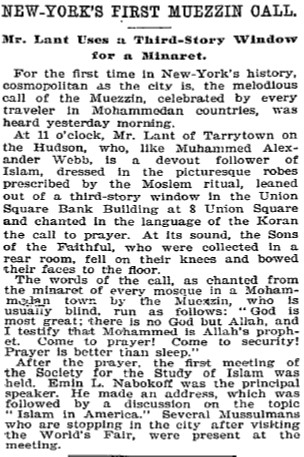
Later the same year, the prayer call was broadcast from a third-story window of the Union Square Bank building in New York City. After John Lant, a convert to Islam and co-founder of First Society for the Study of Islam in America, made the adhan, a congregational prayer was held before the group proceeded with the society’s first meeting.
This moment was documented by The New York Times: “For the first time in New-York’s history, cosmopolitan as the city is, the melodious call of the Muezzin, celebrated by every traveler in Mohammedan countries, was heard yesterday morning.”
Recent broadcasts
Since the 1970s the adhan has been broadcast from mosques in the U.S., such as the American Moslem Society, which was established in Dearborn, Michigan, in 1938 and is arguably the first U.S. mosque to be granted the legal right to transmit all five prayer calls through loudspeakers.
In nearby Hamtramck, considered to be America’s first majority-Muslim city, the adhan was legalized by local government in 2004, when a noise ordinance change was put to a citywide vote. At the time, this stirred notable tensions between Hamtramck’s different faith communities.
In 2020, the city council of Paterson, New Jersey, also authorized the call to prayer between certain hours of the day. In 2023, several mosques in Astoria, New York, received permits to broadcast the five calls to prayer specifically for the duration of the holy month of Ramadan.
Similarly, a small mosque in Occoquan, Virginia, was invited by the local mayor to broadcast the adhan on two separate occasions to mark the month of Ramadan.
The call to prayer in Queens, New York.
Indeed, the public broadcasting of the adhan is part of a larger narrative of American plurality. It is a natural manifestation of Muslim American presence and communal expression.
The fact that the adhan can be heard in the streets of Minneapolis, Hamtramck and Astoria – alongside church bells and other sounds of worship – signifies that Muslim beliefs are not deemed less worthy, nor must they be confined to a private space. It is a sign that Muslims are at home and welcome here.
This post originally appeared at The Conversation.
Leila Tarakji is an assistant professor of religious studies at Michigan State University.
📚🏮🔆📚🏮🔆📚🏮🔆📚🏮

Mecca Comes to Texas: Sugar Land Officials Handed the Town Square to a Pakistani Propagandist—Blacklisted in India—to Broadcast Islamic Supremacy (Video)
 Amy Mek
https://rairfoundation.com/mecca-comes-texas-sugar-land-officials-handed-town/
Thousands of Houston-area Muslims gathered at Sugar Land Town Square for a controversial open-air iftar—organized by Rehan Siddiqi, a blacklisted Pakistani Islamic propagandist—transforming a Texas civic plaza into a stage for religious supremacy and ideological conquest.
Sugar Land, Texas—a once-sleepy American suburb steeped in family values and traditional civic life—is being rapidly transformed. This past Saturday, its heart, Town Square, became the stage for a jarring public display of Islamic “religious” and political power. Thousands of Muslimsgathered not in a mosque, but directly in front of Sugar Land City Hall, for the first-ever open-air Iftar in the region. The event, which was organized by a highly controversial Pakistani-national based in Houston, Rehan Siddiqui, marked far more than the end of a daily Ramadan fast. It marked a territorial and ideological milestone for Texas.
Thousands of Houston-area Muslims gathered at Sugar Land Town Square for a controversial open-air iftar—organized by Rehan Siddiqi, a blacklisted Pakistani Islamic propagandist—transforming a Texas civic plaza into a stage for religious supremacy and ideological conquest.
Sugar Land, Texas—a once-sleepy American suburb steeped in family values and traditional civic life—is being rapidly transformed. This past Saturday, its heart, Town Square, became the stage for a jarring public display of Islamic “religious” and political power. Thousands of Muslimsgathered not in a mosque, but directly in front of Sugar Land City Hall, for the first-ever open-air Iftar in the region. The event, which was organized by a highly controversial Pakistani-national based in Houston, Rehan Siddiqui, marked far more than the end of a daily Ramadan fast. It marked a territorial and ideological milestone for Texas.
The Adhan: A Declaration of Supremacy, Not Solidarity
Organizers billed the event as a message of “unity” and “togetherness.” But for those familiar with Islamic doctrine, the message was clear and unapologetic: Islam is here—not to coexist, but to dominate.
The adhan itself is not a neutral religious chant. It is a theological and political statement. Translated, it declares:
“Allah is greater [than your god]… There is no god but Allah… Muhammad is the messenger of Allah… Come to prayer… Come to success…”
The adhan is a proclamation of Islamic supremacy over all other belief systems. As noted by RAIR Foundation in previous investigations, Islamic texts treat the public proclamation of the adhan as a “flag” of Muslim control. The Hadiths record Muhammad’s military campaigns, where he was said to determine whether to attack or spare a town based on whether the adhan could be heard. If it could, the town was considered Muslim and left alone. If not, it was ripe for conquest.
This mindset is rooted in classical Islamic doctrine, which divides the world into two spheres: Dar al-Islam (the House of Islam) and Dar al-Harb (the House of War). According to Islamic jurisprudence, any territory not under Islamic rule falls into Dar al-Harb—a domain to be brought under submission, either through da’wah (invitation) or jihad (struggle). The public proclamation of the adhan in non-Muslim lands is not just religious—it’s symbolic of the transition from Dar al-Harb toward Dar al-Islam. In this framework, the adhan serves as both a spiritual call and a political marker of territorial claim.
Former imam Tomas Samuel warns that under Islamic law, “the adhan shows power and control over the country.” In his words:
“Its proclamation shows that the people of the city are Muslims.”
This is not theoretical. It’s historical, doctrinal, and strategic.
But perhaps the most chilling modern indictment comes from ex-Muslim Ridvan Aydemir, known as the Apostate Prophet—a former devout Sunni Muslim who fled Islamic persecution in Turkey only to be confronted by the same Islamic supremacy in the streets of Europe and North America.
“The adhan is a warlike declaration,” says Aydemir. “It declares all religions except Islam to be false. Blasting it in Western cities is like singing and broadcasting Nazi songs in Jewish neighborhoods.”
Aydemir speaks for countless apostates—those who fled regimes where leaving Islam is a death sentence.
“Imagine escaping a country where you could be jailed, lynched, or tortured for rejecting Islam… and then arriving in America—only to hear the same dominating supremacist marchblaring from city squares.”
He continues:
“There is no religious obligation for Muslims to blast the adhan in non-Muslim cities. This is not about worship. It’s about power.”
And to those too timid to object, Aydemir offers a dose of moral clarity:
“You are not bigoted. You’re not Islamophobic. You’re simply rejecting a shameless, disturbing practice of religious supremacism.”
These are not the words of a politician or a pundit. They are the lived experience of a man who left Islam, was disowned by his family, and came to the West seeking freedom—only to witness the same ideological system creeping into public life, now dressed in the language of “diversity.”
Organizers billed the event as a message of “unity” and “togetherness.” But for those familiar with Islamic doctrine, the message was clear and unapologetic: Islam is here—not to coexist, but to dominate.
The adhan itself is not a neutral religious chant. It is a theological and political statement. Translated, it declares:
“Allah is greater [than your god]… There is no god but Allah… Muhammad is the messenger of Allah… Come to prayer… Come to success…”
The adhan is a proclamation of Islamic supremacy over all other belief systems. As noted by RAIR Foundation in previous investigations, Islamic texts treat the public proclamation of the adhan as a “flag” of Muslim control. The Hadiths record Muhammad’s military campaigns, where he was said to determine whether to attack or spare a town based on whether the adhan could be heard. If it could, the town was considered Muslim and left alone. If not, it was ripe for conquest.
This mindset is rooted in classical Islamic doctrine, which divides the world into two spheres: Dar al-Islam (the House of Islam) and Dar al-Harb (the House of War). According to Islamic jurisprudence, any territory not under Islamic rule falls into Dar al-Harb—a domain to be brought under submission, either through da’wah (invitation) or jihad (struggle). The public proclamation of the adhan in non-Muslim lands is not just religious—it’s symbolic of the transition from Dar al-Harb toward Dar al-Islam. In this framework, the adhan serves as both a spiritual call and a political marker of territorial claim.
Former imam Tomas Samuel warns that under Islamic law, “the adhan shows power and control over the country.” In his words:
“Its proclamation shows that the people of the city are Muslims.”
This is not theoretical. It’s historical, doctrinal, and strategic.
But perhaps the most chilling modern indictment comes from ex-Muslim Ridvan Aydemir, known as the Apostate Prophet—a former devout Sunni Muslim who fled Islamic persecution in Turkey only to be confronted by the same Islamic supremacy in the streets of Europe and North America.
“The adhan is a warlike declaration,” says Aydemir. “It declares all religions except Islam to be false. Blasting it in Western cities is like singing and broadcasting Nazi songs in Jewish neighborhoods.”
Aydemir speaks for countless apostates—those who fled regimes where leaving Islam is a death sentence.
“Imagine escaping a country where you could be jailed, lynched, or tortured for rejecting Islam… and then arriving in America—only to hear the same dominating supremacist marchblaring from city squares.”
He continues:
“There is no religious obligation for Muslims to blast the adhan in non-Muslim cities. This is not about worship. It’s about power.”
And to those too timid to object, Aydemir offers a dose of moral clarity:
“You are not bigoted. You’re not Islamophobic. You’re simply rejecting a shameless, disturbing practice of religious supremacism.”
These are not the words of a politician or a pundit. They are the lived experience of a man who left Islam, was disowned by his family, and came to the West seeking freedom—only to witness the same ideological system creeping into public life, now dressed in the language of “diversity.”
The Man Behind the Mic: Who Is Rehan Siddiqi?
While the crowd in Sugar Land knelt for prayer and the loudspeakers blasted the adhan across Town Square, few paused to ask the most basic question:
Who organized this? Who was given the power to turn a Texas civic center into a proxy for Mecca—and why?
The answer should disturb every American who cares about national sovereignty, religious liberty, and the sanctity of public space.
Rehan Siddiqi, a Pakistani-born media mogul based in Houston, is no innocent event promoter. He owns and operates several South Asian radio stations—Hum FM 103.5, KGOL 1180 AM, and more—targeting Muslim and immigrant communities across Texas. But behind the smiling stage presence is a deeply controversial figure: he is on the radar of Indian agencies and has been blacklisted by the Indian Governement, accused of anti-Hindu and anti-India propaganda, and allegedly connected to Pakistan’s Inter-Services Intelligence (ISI).
In 2020, India’s Ministry of Home Affairs blacklisted Siddiqi, warning Bollywood actors not to associate with him. Why? Because he was accused of leveraging concerts and radio platforms in the U.S. to amplify anti-Citizenship Amendment Act (CAA) protests, promote Kashmir separatism, and support pro-Khalistan narratives—all of which align with the strategic goals of the ISI, Pakistan’s notorious intelligence agency known for its role in terrorism, propaganda, and destabilization efforts across South Asia.
The ISI has been implicated by Indian, British, and American intelligence agencies in coordinating the 2008 Mumbai terror attacks—a four-day Islamist siege that left 166 people dead and over 300 injured. The assault, carried out by Pakistan-based Lashkar-e-Taiba (LeT), specifically targeted Westerners, Jews, and Hindus, and was facilitated with ISI support through U.S.-convicted conspirator David Headley.
The CAA—passed by India in 2019—offers fast-tracked citizenship to persecuted religious minorities (Hindus, Sikhs, Christians, Buddhists, and Jains) fleeing Islamic countries like Pakistan, Bangladesh, and Afghanistan. It excludes Muslims—not out of hatred, but because Muslims are not religious minorities in those countries. It was a humanitarian law meant to rescue the victims of Islamic oppression.
Siddiqi’s opposition to the CAA wasn’t about civil rights—it was allegedly about advancing the Islamic narrative that Hindus have no right to defend their civilization. By promoting anti-CAA propaganda on American soil, Siddiqi was allegedly attacking India’s sovereignty, demonizing Hindus, and doing the ideological bidding of Pakistan’s intelligence services.
“He owns a radio channel and brings Indian artists to Houston… He uses his platforms to run anti-India propaganda,” said a concerned Indian community leader in Houston.
Siddiqi’s media network was also accused of spreading anti-India disinformation in the wake of the 2019 Pulwama terror attack—where a Pakistan-backed jihadist murdered 40 Indian soldiers in a suicide bombing. The attack was carried out by Jaish-e-Mohammed, a terrorist group openly sheltered by Pakistan’s military. In response, India launched airstrikes on a terrorist training camp in Balakot, deep inside Pakistani territory. These retaliatory strikes were a national defense action—akin to how America responded after 9/11. Yet instead of condemning the terrorists, Siddiqi’s radio channels allegedly amplified Pakistani talking points that blamed India, downplayed the attacks, and smeared India’s leadership.
His political alignment is unmistakable: pro-Pakistan, anti-Hindu, anti-India—and now aggressively exported into American civic life. Through concerts, radio shows, and so-called ‘community events,’ Siddiqi is said to promote the same ideological narratives used by Pakistan’s intelligence agencies to destabilize India. The fact that this propaganda is now being broadcast across Texas, under the guise of ‘multicultural celebration,’ should alarm every American who values truth, sovereignty, and freedom.
And yet, despite these red flags, he was granted the public square in Sugar Land—a peaceful, Christian-rooted community—to publicly broadcast a supremacist religious ritual, the adhan, declaring Allah’s dominion over all.
This wasn’t cultural coexistence. This was a symbolic conquest—spearheaded by a man who has championed ideologies hostile to Hindus, hostile to India, and deeply incompatible with Western civic values.
In 2024, Bollywood actress Madhuri Dixit came under fire for partnering with Siddiqi in Houston. Hindu and Indian diaspora groups were outraged that a national icon would collaborate with a man accused of fronting foreign propaganda operations tied to Pakistan’s intelligence apparatus.
“His events are not entertainment. They’re smokescreens for deeper political agendas,” one Indian outlet warned.
So why did the Sugar Land City Council approve this event?
Why would a man—blacklisted by a key U.S. ally, linked to a hostile foreign intelligence agency, and accused of anti-Hindu radical messaging—be handed a public square to stage a religious-political ritual that Muslims themselves describe as a declaration of supremacy?
This isn’t poor judgment. It is a humiliating betrayal of the American people—of Christian Texans, of Hindu Americans, and of every taxpayer whose civic spaces are being surrendered to foreign propagandists with theocratic goals.
While the crowd in Sugar Land knelt for prayer and the loudspeakers blasted the adhan across Town Square, few paused to ask the most basic question:
Who organized this? Who was given the power to turn a Texas civic center into a proxy for Mecca—and why?
The answer should disturb every American who cares about national sovereignty, religious liberty, and the sanctity of public space.
Rehan Siddiqi, a Pakistani-born media mogul based in Houston, is no innocent event promoter. He owns and operates several South Asian radio stations—Hum FM 103.5, KGOL 1180 AM, and more—targeting Muslim and immigrant communities across Texas. But behind the smiling stage presence is a deeply controversial figure: he is on the radar of Indian agencies and has been blacklisted by the Indian Governement, accused of anti-Hindu and anti-India propaganda, and allegedly connected to Pakistan’s Inter-Services Intelligence (ISI).
In 2020, India’s Ministry of Home Affairs blacklisted Siddiqi, warning Bollywood actors not to associate with him. Why? Because he was accused of leveraging concerts and radio platforms in the U.S. to amplify anti-Citizenship Amendment Act (CAA) protests, promote Kashmir separatism, and support pro-Khalistan narratives—all of which align with the strategic goals of the ISI, Pakistan’s notorious intelligence agency known for its role in terrorism, propaganda, and destabilization efforts across South Asia.
The ISI has been implicated by Indian, British, and American intelligence agencies in coordinating the 2008 Mumbai terror attacks—a four-day Islamist siege that left 166 people dead and over 300 injured. The assault, carried out by Pakistan-based Lashkar-e-Taiba (LeT), specifically targeted Westerners, Jews, and Hindus, and was facilitated with ISI support through U.S.-convicted conspirator David Headley.
The CAA—passed by India in 2019—offers fast-tracked citizenship to persecuted religious minorities (Hindus, Sikhs, Christians, Buddhists, and Jains) fleeing Islamic countries like Pakistan, Bangladesh, and Afghanistan. It excludes Muslims—not out of hatred, but because Muslims are not religious minorities in those countries. It was a humanitarian law meant to rescue the victims of Islamic oppression.
Siddiqi’s opposition to the CAA wasn’t about civil rights—it was allegedly about advancing the Islamic narrative that Hindus have no right to defend their civilization. By promoting anti-CAA propaganda on American soil, Siddiqi was allegedly attacking India’s sovereignty, demonizing Hindus, and doing the ideological bidding of Pakistan’s intelligence services.
“He owns a radio channel and brings Indian artists to Houston… He uses his platforms to run anti-India propaganda,” said a concerned Indian community leader in Houston.
Siddiqi’s media network was also accused of spreading anti-India disinformation in the wake of the 2019 Pulwama terror attack—where a Pakistan-backed jihadist murdered 40 Indian soldiers in a suicide bombing. The attack was carried out by Jaish-e-Mohammed, a terrorist group openly sheltered by Pakistan’s military. In response, India launched airstrikes on a terrorist training camp in Balakot, deep inside Pakistani territory. These retaliatory strikes were a national defense action—akin to how America responded after 9/11. Yet instead of condemning the terrorists, Siddiqi’s radio channels allegedly amplified Pakistani talking points that blamed India, downplayed the attacks, and smeared India’s leadership.
His political alignment is unmistakable: pro-Pakistan, anti-Hindu, anti-India—and now aggressively exported into American civic life. Through concerts, radio shows, and so-called ‘community events,’ Siddiqi is said to promote the same ideological narratives used by Pakistan’s intelligence agencies to destabilize India. The fact that this propaganda is now being broadcast across Texas, under the guise of ‘multicultural celebration,’ should alarm every American who values truth, sovereignty, and freedom.
And yet, despite these red flags, he was granted the public square in Sugar Land—a peaceful, Christian-rooted community—to publicly broadcast a supremacist religious ritual, the adhan, declaring Allah’s dominion over all.
This wasn’t cultural coexistence. This was a symbolic conquest—spearheaded by a man who has championed ideologies hostile to Hindus, hostile to India, and deeply incompatible with Western civic values.
In 2024, Bollywood actress Madhuri Dixit came under fire for partnering with Siddiqi in Houston. Hindu and Indian diaspora groups were outraged that a national icon would collaborate with a man accused of fronting foreign propaganda operations tied to Pakistan’s intelligence apparatus.
“His events are not entertainment. They’re smokescreens for deeper political agendas,” one Indian outlet warned.
So why did the Sugar Land City Council approve this event?
Why would a man—blacklisted by a key U.S. ally, linked to a hostile foreign intelligence agency, and accused of anti-Hindu radical messaging—be handed a public square to stage a religious-political ritual that Muslims themselves describe as a declaration of supremacy?
This isn’t poor judgment. It is a humiliating betrayal of the American people—of Christian Texans, of Hindu Americans, and of every taxpayer whose civic spaces are being surrendered to foreign propagandists with theocratic goals.
From Mecca to Sugar Land: Why Is Islam Recreating Sacred, Segregated Spaces in Texas?
The event in Sugar Land included a jarring visual: images of the Hajj—a religious rite legally forbidden to all non-Muslims. Mecca, the birthplace of Islam and the site of the Hajj, is 100% off-limits to Christians, Jews, Hindus, Buddhists, atheists—anyone who is not Muslim.
This is not cultural preference. It is codified law.
Under Saudi legislation, non-Muslims who enter Mecca or Medina face immediate deportation, imprisonment, and lifetime bans. This isn’t coexistence. It is religious apartheid—an extreme form of exclusion that no other faith on Earth enforces.
Think about it:
- You can walk through the Vatican, no matter your faith.
- You can visit Jerusalem whether you are Jewish, Muslim, or Christian.
- You can attend services in a Hindu temple or a Buddhist monastery, regardless of your beliefs.
But Mecca? Off limits. No exceptions.
Now ask yourself:
Do Christians in Pakistan hold outdoor Easter celebrations in front of Karachi’s city hall, blasting recordings of the Pope, or livestreaming Christmas Mass from the Vatican?
Do Hindus in Cairo project footage of Diwali celebrations onto government buildings while chanting Vedic mantras over city loudspeakers?
Of course not. Because in most Muslim-majority nations, such actions would be considered blasphemous—and would likely end in arrest, mob violence, or worse.
And yet here in Texas, Muslim organizers are recreating Mecca in the public square—in taxpayer-funded civic spaces that belong to all Texans. They are broadcasting rituals that non-Muslims are legally forbidden from participating in at the source. All while journalists gush over “diversity,” and critics are shamed into silence.
This is not a celebration of pluralism. This is a one-way street paved in submission.
The event in Sugar Land included a jarring visual: images of the Hajj—a religious rite legally forbidden to all non-Muslims. Mecca, the birthplace of Islam and the site of the Hajj, is 100% off-limits to Christians, Jews, Hindus, Buddhists, atheists—anyone who is not Muslim.
This is not cultural preference. It is codified law.
Under Saudi legislation, non-Muslims who enter Mecca or Medina face immediate deportation, imprisonment, and lifetime bans. This isn’t coexistence. It is religious apartheid—an extreme form of exclusion that no other faith on Earth enforces.
Think about it:
- You can walk through the Vatican, no matter your faith.
- You can visit Jerusalem whether you are Jewish, Muslim, or Christian.
- You can attend services in a Hindu temple or a Buddhist monastery, regardless of your beliefs.
But Mecca? Off limits. No exceptions.
Now ask yourself:
Do Christians in Pakistan hold outdoor Easter celebrations in front of Karachi’s city hall, blasting recordings of the Pope, or livestreaming Christmas Mass from the Vatican?
Do Hindus in Cairo project footage of Diwali celebrations onto government buildings while chanting Vedic mantras over city loudspeakers?
Of course not. Because in most Muslim-majority nations, such actions would be considered blasphemous—and would likely end in arrest, mob violence, or worse.
And yet here in Texas, Muslim organizers are recreating Mecca in the public square—in taxpayer-funded civic spaces that belong to all Texans. They are broadcasting rituals that non-Muslims are legally forbidden from participating in at the source. All while journalists gush over “diversity,” and critics are shamed into silence.
This is not a celebration of pluralism. This is a one-way street paved in submission.
Street Prayers as Power Projections
This public Iftar is not an isolated event. It is part of a global strategy.
From Paris to Berlin to London, mass street prayers are increasingly used as tools of Islamic encroachment. Loudspeakers fill the air with the adhan. Worshippers kneel shoulder to shoulder, blocking traffic and halting public life. It is not about prayer—it is about territorial assertion.
Marine Le Pen of France put it bluntly:
“It is an occupation—without tanks or soldiers.”
The German political party Alternative für Deutschland called the adhan a “land grab.”
That is not hyperbole. It is an accurate description of what happened Saturday in Sugar Land.
The message to Texans was clear: We are here. We are visible. We are organized. This space is ours now.
And it’s not just a one-night spectacle. As the organizer, Rehan Siddiqi boasted to the crowd:
“I hope this becomes a tradition every year right here at the Sugar Land Town Square.”
This public Iftar is not an isolated event. It is part of a global strategy.
From Paris to Berlin to London, mass street prayers are increasingly used as tools of Islamic encroachment. Loudspeakers fill the air with the adhan. Worshippers kneel shoulder to shoulder, blocking traffic and halting public life. It is not about prayer—it is about territorial assertion.
Marine Le Pen of France put it bluntly:
“It is an occupation—without tanks or soldiers.”
The German political party Alternative für Deutschland called the adhan a “land grab.”
That is not hyperbole. It is an accurate description of what happened Saturday in Sugar Land.
The message to Texans was clear: We are here. We are visible. We are organized. This space is ours now.
And it’s not just a one-night spectacle. As the organizer, Rehan Siddiqi boasted to the crowd:
“I hope this becomes a tradition every year right here at the Sugar Land Town Square.”
“Peace,” They Say—But What Comes Next?
Organizers insisted the event was about love and unity. But Islamic history and doctrine tell a different story.
“Islam must dominate and not be dominated.”
This isn’t a slogan—it’s a central pillar of Islamic jurisprudence. The Arabic phrase “Al-Islam ya’lu wa la yu’la ‘alayh”—translated as “Islam is superior and is not to be surpassed”—has been taught for centuries in Islamic legal texts. It is echoed by figures like Sayyid Qutb, Abul A’la Maududi, and the Muslim Brotherhood, and it continues to define Islamic political thought to this day.
And it’s not just a theory. We are watching it unfold—right now—in Texas and across the West.
This is not a warning. This is a status report.
RAIR Foundation has already documented that:
- Halal-only food mandates are being implemented in Texas public institutions—including public schools and hospitals—forcing taxpayers to fund Islamic dietary compliance
(See: “Halal Mandates & Sharia Deception: How Texas Is Funding Its Own Islamization”) - Textbooks are being whitewashed to sanitize jihad, reframe Islamic conquest as peaceful, and remove anything deemed “Islamophobic”
- Lawsuits and legal threats are increasingly used to silence criticism of Islam—under the weaponized label of “hate speech”
- Islamic dress codes, gender-based separation, and Sharia-compliant arbitration are spreading in private schools, religious centers, and even legal mediation forums under the guise of “accommodation”
This is not “creeping Sharia”—it is open, aggressive Islamization, happening in full view of a complacent public and a cowardly and complicit political class.
The open-air Iftar in Sugar Land is not the beginning.
It is another step in a well-documented campaign to normalize Islamic supremacy under the banner of multiculturalism.
Organizers insisted the event was about love and unity. But Islamic history and doctrine tell a different story.
“Islam must dominate and not be dominated.”
This isn’t a slogan—it’s a central pillar of Islamic jurisprudence. The Arabic phrase “Al-Islam ya’lu wa la yu’la ‘alayh”—translated as “Islam is superior and is not to be surpassed”—has been taught for centuries in Islamic legal texts. It is echoed by figures like Sayyid Qutb, Abul A’la Maududi, and the Muslim Brotherhood, and it continues to define Islamic political thought to this day.
And it’s not just a theory. We are watching it unfold—right now—in Texas and across the West.
This is not a warning. This is a status report.
RAIR Foundation has already documented that:
- Halal-only food mandates are being implemented in Texas public institutions—including public schools and hospitals—forcing taxpayers to fund Islamic dietary compliance
(See: “Halal Mandates & Sharia Deception: How Texas Is Funding Its Own Islamization”) - Textbooks are being whitewashed to sanitize jihad, reframe Islamic conquest as peaceful, and remove anything deemed “Islamophobic”
- Lawsuits and legal threats are increasingly used to silence criticism of Islam—under the weaponized label of “hate speech”
- Islamic dress codes, gender-based separation, and Sharia-compliant arbitration are spreading in private schools, religious centers, and even legal mediation forums under the guise of “accommodation”
This is not “creeping Sharia”—it is open, aggressive Islamization, happening in full view of a complacent public and a cowardly and complicit political class.
The open-air Iftar in Sugar Land is not the beginning.
It is another step in a well-documented campaign to normalize Islamic supremacy under the banner of multiculturalism.
Are These “Traditions”—or Imported Theocratic Practices?
Many attendees were quoted saying they were not there for food, but for “community.” One Jordanian resident put it plainly:
“I was so happy to hear the adhan with this group of Muslims.”
Another Pakistani immigrant emphasized bringing his children so they could learn the “cultural essence” of Ramadan and public prayer.
But what “culture” are we importing? And why does it require occupying American public space, instead of practicing privately like every other faith?
The answer is that this is not just a cultural expression. It is ideological planting.
Just as the Al-Hadi School in Houston simulates the Hajj and enforces strict Shia doctrine aligned with Iran, this event represents the visible spread of Islamic law, practice, and segregationist norms into the American public square.
Under Sharia:
- A Muslim man’s life is worth more than a woman’s.
- A Muslim’s life is worth more than a non-Muslim’s.
- Dhimmis (non-Muslims) must pay a tax (Jizya) just to exist.
- Religious minorities are barred from building new houses of worship.
- Non-Muslims cannot hold office, own weapons, or publicly express their faith.
This is not “faith.” This is civilizational architecture—and it is being erected in Texas, one symbolic brick at a time.
Many attendees were quoted saying they were not there for food, but for “community.” One Jordanian resident put it plainly:
“I was so happy to hear the adhan with this group of Muslims.”
Another Pakistani immigrant emphasized bringing his children so they could learn the “cultural essence” of Ramadan and public prayer.
But what “culture” are we importing? And why does it require occupying American public space, instead of practicing privately like every other faith?
The answer is that this is not just a cultural expression. It is ideological planting.
Just as the Al-Hadi School in Houston simulates the Hajj and enforces strict Shia doctrine aligned with Iran, this event represents the visible spread of Islamic law, practice, and segregationist norms into the American public square.
Under Sharia:
- A Muslim man’s life is worth more than a woman’s.
- A Muslim’s life is worth more than a non-Muslim’s.
- Dhimmis (non-Muslims) must pay a tax (Jizya) just to exist.
- Religious minorities are barred from building new houses of worship.
- Non-Muslims cannot hold office, own weapons, or publicly express their faith.
This is not “faith.” This is civilizational architecture—and it is being erected in Texas, one symbolic brick at a time.
This Isn’t Integration. It’s Colonization.
Americans must ask themselves a hard question:
Is this religious freedom? Or is this religious supremacy hiding behind the First Amendment?
While Muslims in the West are free to broadcast supremacy, non-Muslims are banned entirely from Islamic holy cities. This is not mutual tolerance. It is a one-way street.
Worse, our schools are simulating rituals we can never attend. Our cities are hosting public prayers from a religion that declares all others false. And our politicians call this “diversity” while ignoring its deadly implications for civic life, liberty, and pluralism.
Sugar Land was a test. A soft conquest cloaked in smiles and Iftar dinners. A charm offensive.
Next year, it may be your town square. Your city hall. Your children’s curriculum.
Your legal system.
What happens next depends on whether this state—this country—has the courage to stop it.
Americans must ask themselves a hard question:
Is this religious freedom? Or is this religious supremacy hiding behind the First Amendment?
While Muslims in the West are free to broadcast supremacy, non-Muslims are banned entirely from Islamic holy cities. This is not mutual tolerance. It is a one-way street.
Worse, our schools are simulating rituals we can never attend. Our cities are hosting public prayers from a religion that declares all others false. And our politicians call this “diversity” while ignoring its deadly implications for civic life, liberty, and pluralism.
Sugar Land was a test. A soft conquest cloaked in smiles and Iftar dinners. A charm offensive.
Next year, it may be your town square. Your city hall. Your children’s curriculum.
Your legal system.
What happens next depends on whether this state—this country—has the courage to stop it.
Call to Action: Hold Sugar Land Officials Accountable
The Islamic takeover of Sugar Land’s Town Square did not happen in a vacuum. It happened with the explicit approval and complicity of your elected officials. While residents celebrated Easter and prepared for Passover, the Sugar Land City Council ceded your civic space to a blacklisted Pakistani propagandist, allowed the supremacist Islamic adhan to be broadcast over public property, and enabled a foreign-linked ideological event that openly declared the supremacy of Islam over all others.
Ask yourself:
- Why was a man with alleged ties to Pakistani intelligence allowed to control a public square in Texas?
- Why were taxpayer-funded civic spaces used for religious dominance, not civic unity?
- Why was no alternative viewpoint allowed?
- And why are your elected officials silent?
Every member of the Sugar Land City Council owes their voters an explanation:
At-Large Council Member William Ferguson
At-Large Council Member Jennifer J. Lane
District 1 Council Member Suzanne Whatley
District 2 Council Member Naushad Kermally
District 3 Council Member Stewart Jacobson
District 4 Council Member Carol K. McCutcheon.
Demand answers. Demand transparency. Demand accountability.
If this event becomes an annual tradition, it will not be because Islam demanded it—it will be because you stayed silent while your leaders handed over your town square.
📞 Call your council members: Ph: 281-275-2313
📞 Call the Office of the City Secretary (281) 275-2730
🗳️ Prepare to vote them out.
This is not about religion. It’s about national sovereignty, equal rights for all, the integrity of public space, and the future of your city.
Speak now—or Sugar Land becomes the blueprint for every town across Texas.
The Islamic takeover of Sugar Land’s Town Square did not happen in a vacuum. It happened with the explicit approval and complicity of your elected officials. While residents celebrated Easter and prepared for Passover, the Sugar Land City Council ceded your civic space to a blacklisted Pakistani propagandist, allowed the supremacist Islamic adhan to be broadcast over public property, and enabled a foreign-linked ideological event that openly declared the supremacy of Islam over all others.
Ask yourself:
- Why was a man with alleged ties to Pakistani intelligence allowed to control a public square in Texas?
- Why were taxpayer-funded civic spaces used for religious dominance, not civic unity?
- Why was no alternative viewpoint allowed?
- And why are your elected officials silent?
Every member of the Sugar Land City Council owes their voters an explanation:
At-Large Council Member William Ferguson
At-Large Council Member Jennifer J. Lane
District 1 Council Member Suzanne Whatley
District 2 Council Member Naushad Kermally
District 3 Council Member Stewart Jacobson
District 4 Council Member Carol K. McCutcheon.
Demand answers. Demand transparency. Demand accountability.
If this event becomes an annual tradition, it will not be because Islam demanded it—it will be because you stayed silent while your leaders handed over your town square.
📞 Call your council members: Ph: 281-275-2313
📞 Call the Office of the City Secretary (281) 275-2730
🗳️ Prepare to vote them out.
This is not about religion. It’s about national sovereignty, equal rights for all, the integrity of public space, and the future of your city.
Speak now—or Sugar Land becomes the blueprint for every town across Texas.
⭕️⭕️⭕️⭕️⭕️⭕️⭕️⭕️⭕️⭕️⭕️⭕️⭕️⭕️
Please be patient for every post to upload it’s worth the wait. Thank you. 𝒜 𝒫𝓁𝒶𝒸𝑒 𝐹𝑜𝓇 𝐻𝑜𝓅𝑒 𝒶𝓃𝒹 𝒟𝓇𝑒𝒶𝓂𝓈 𝒶𝓃𝒹 𝐵𝑒𝓈𝓉 𝐵𝑒𝒶𝓊𝓉𝒾𝒻𝓊𝓁 𝐵𝑜𝑜𝓀𝓈 𝒶𝓃𝒹 𝒥𝑜𝓊𝓇𝓃𝒶𝓁𝓈 𝐼𝓃 𝒯𝒽𝑒 𝒲𝑜𝓇𝓁𝒹 ~ 𝐼𝓃𝒸𝓁𝓊𝒹𝒾𝓃𝑔 𝓉𝒽𝑒 𝐿𝒾𝓉𝓉𝓁𝑒 𝐻𝑜𝓊𝓈𝑒 𝑜𝒻 𝑀𝒾𝓇𝒶𝒸𝓁𝑒𝓈 All books and journals by Laurel Sobol are available online at Barns and Noble bn.com https://www.barnesandnoble.com/s/Laurel%20Sobol
⭐️⭐️⭐️⭐️⭐️
BeCause your body mind and soul deserve the best organic Lifestyle Today!
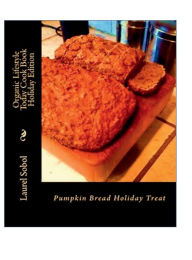
Organic Lifestyle Today Cook Book Holiday Edition!
- Hardcover w/ Printed Case
- 8.5" x 11"
- 88 pages
- List Price: $22.99
- On Sale: Sep 13, 2022
ISBN: 9798823115490

- Hardcover w/ Printed Case
- 8.5" x 11"
- 88 pages
- List Price: $22.99
- On Sale: Sep 13, 2022
Comments